
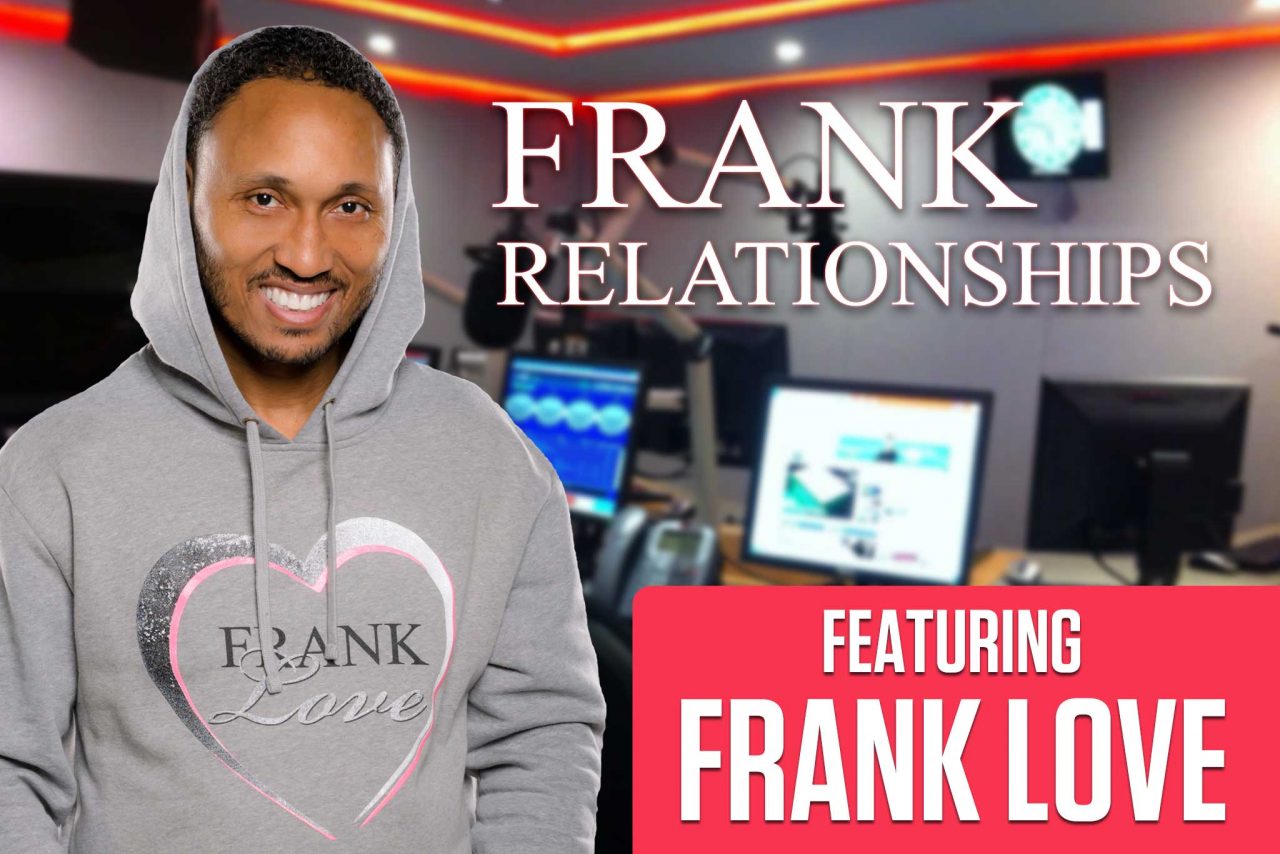
Podcast Episode:
This week we’re joined by a Psychic, Certified Practitioner of Hypnosis, and author. Wanna know what’s in your future? I promise you … it’s a fun guest.
Links to the week’s guest: twodragons.com and cynthiachauvin.com.
FRANK RELATIONSHIPS:
HOW TO CREATE A 21ST CENTURY RELATIONSHIP
Guests: Cynthia Chauvin
Frank: This week we’re joined by a psychic certified practitioner of hypnosis and author. Want to know what’s in your future? I promise you, it’s a fun guest.
Welcome to Frank Relationships, where we provide a candid, fresh and frank look into relationships with goals of acceptance, respect and flexibility. I’m Frank Love and you can find me, my blog and my various social media incarnations at franklove.com.
Once again I’m joined by my co-host Dr. Gayle. She has a doctorate in psychology and ain’t afraid to use it. What’s up Dr. Gayle?
Dr. Gayle: Good morning, Frank.
Frank: This week we’re joined by Cynthia Chauvin, a bonafide New Orleans’ psychic and a certified practitioner of hypnosis. But that’s not all, she’s also an author. And she’s here today to tell us all about the 10 ways. The 10 ways of doing what you might ask. Well, you’re about to find out. So, if you want to know how to create a 21st century relationship, how to keep your man and what the “shame blame” game is, join me as I welcome the extraordinarily talented, Cynthia Chauvin to the show. Welcome, Cynthia.
Cynthia: Good morning, Frank. Good morning, Gayle.
Dr. Gayle: Good morning.
Frank: Question number one. What is a 21st century relationship?
Cynthia: The 21st century relationship is based on having a primary relationship with yourself before seeking a relationship with others. It’s to groom the knowledge and the consistency and congruency with your own spirit, your own inner workings, your own inner child, your own inner experiences, so that when you develop a relationship with another person, it’s actually the other person.
Frank: You trying to tell me if I get closer with myself I can find a man? Oh, a partner, a woman?
Cynthia: Finding a man is very easy, having functioning relationship is a different situation altogether. It’s not about finding somebody. It’s about developing and keeping a relationship that is productive and rewarding to both people.
Frank: What if I just want to be in a marriage? I just want to be married. All that other stuff about productivity, happiness, hey my primary thing is to tell my girlfriends, I got a man.
Cynthia: Right, right. Well, that can work for a bit, but it tends to get a little boring after awhile and I haven’t seen it to be very successful. Usually, sooner or later one starts becoming—I want to say aggressive, grabby, projective, and one of the two will leave. It’s difficult and it’s not fun. There’s no fun. Where’s the fun in just having an ottoman in your house, without putting your feet on it and enjoying it? Well, what’s the fun of having a relationship that’s just based in a statue?
Frank: But if I find a man, if I have a man—if he decides he wants to leave, hey I just take him for all he’s got.
Dr. Gayle: But then, what if he’s broke?
Cynthia: I’ve seen it work both ways. I’ve seen the men take the women for all they’ve got. I’ve seen the women take the men for all they’ve got. But again, we’re talking about self-satisfaction. We’re talking about having someone that when you’re in the relationship, you’re actually in the relationship with the other individual. You’re experiencing who they are and that’s very creative, very unusual. We usually only experience our projections of our reality in a relationship. We experience what we have alienated from ourselves as a need, a want, a desire that we’re trying to fill, by this other individual. So, you can—
Dr. Gayle: So, when you say, “We only experience the projections of ourself,” can you elaborate on that?
Cynthia: Well, in my world’s view, we’re ruled by our subconscious mind, that the world is created on the external by what we have ingested on the internal in our primary years. Whether that be from the culture, religion, parents, family dynamics, we create coping skills and develop behavior patterns in order to survive, create a sense of safety, create a sense of value of ourselves. And until those things are updated into a current connective conversation with ourselves, but we know what we’re doing and we know why we’re doing it, we’re never really in the relationship with the other individual. We don’t see the individual. We only see the unresolved issues of ourselves that we’re trying to manipulate, control, cajole or otherwise put a texture to it so we can satisfy it. Does that make sense to you?
Dr. Gayle: It totally makes sense to me.
Cynthia: I figured it would.
Dr. Gayle: In psychology we call that psychoanalytic view.
Cynthia: Oh, okay.
Dr. Gayle: Right and so—
Cynthia: I call it Chauvin view.
Dr. Gayle: Right. So, we build upon our current experiences based on how we developed as a child; through development, like I said as a child, through adolescence and early adulthood. And if we miss any one of those steps, then how we react or act as an adult, plays back on what stage we didn’t develop or wasn’t developed fully as a child.
Cynthia: Uh-huh.
Dr. Gayle: Which you talk about the little girl—“disappointed little girl” in your book. I believe that’s what you stated.
Cynthia: Yeah.
Dr. Gayle: Uh-huh.
Cynthia: There’s tons of them in there. I think we’re a very fractionated people in our developmental skills. I think that it was a survival technique and I think it has functioned to the degree that’s functioned. But I think it creates dysfunctional relationships.
Frank: Let’s jump in to your book which is called, The Ten Ways: How to Create a 21st Century Relationship. What is the “shame blame” game?
Cynthia: Well, we learn that by obedience in childhood. So, parents and God bless them, we all do it. As a parent, I’ve done it and as my parents have done it before. We use the tools that we have and shame and blame is one of the basic ones. “Wow, gee whiz, it’s your fault. Gee whiz, you’re to blame for this,” instead of powering the individual with a sense of self and that it was just a choice and that perhaps this choice wasn’t the wisest choice.
So, we develop these tools to get people in order in our lives and we will shame them and we will blame them and I think that’s kind of self-explanatory. We’ll use one of the two, depending upon what our expertise lies in and usually both. I I’ve seen a jambalaya of shame and blame and a few other things in there to get people under control, to get them to do what we want them to do, when we want them to do it and how we want them to do it; so that we can feel safe, so that we can feel valuable, so that we can feel that somebody is the authority of the world and that they cherish us. And in actuality all it does is create a rebellious communication at the best; rebellious.
Dr. Gayle: So, in a sense we blame other people in order to control them and control the relationship?
Cynthia: Oh, yeah.
Dr. Gayle: And so how do we—
Cynthia: Control our environment
Dr. Gayle: Uh-huh.
Cynthia: Control our environment. We’re really looking to control the environment—I believe—verses the individual. The individual is just an extension of the environment. So, I don’t think it’s so much that, “Gee whiz I want to control him or I want to control her or I’m going to make you feel bad about this. You didn’t call me. You didn’t call me at 6:00 P.M. and you told me you were going to call me at 6:00 P.M.” So, we try to shame the person into an action that they won’t do that again, but it’s really trying to—in my mind’s eye—control the elements, the environment, so that we can feel safer. “That I know you’re going to call me at 6:00 P.M. next time, because I made you feel so damn bad that you didn’t call me this time, that you’re going to remember next time.” And of course then that creates a rebellion on the other person’s part, because they want to be acknowledged.
Frank: What about how we shame and blame ourselves?
Cynthia: That’s a good one. That’s a good one. That’s an internal dialogue. I got that one down pat. We can do that all day long. That’s a never-ending loop of repetitive information, of “You should of done this,” and “You could have done that,” and “Why the hell didn’t you do this over here,” and “You should’ve known better, because you thought you should’ve seen that coming.”
Frank: Is that—
Cynthia: Sound familiar?
Frank: Oh, very.
Dr. Gayle: Most definitely.
Frank: Now, is that part of the problem of “why?” How do we incorporate the problem of “why” into it and I’m interjecting this as directly from your book?
Cynthia: Well, again there is no “why” that satisfies. We can change the loop, but we can’t change the “why,” because the “why” is a moving target. It keeps on morphing itself into some kind of information to keep you going, like a carrot. Like you’re running after something, like you’re really going to figure it out. It’s just way too complex. Even if you get down to the core, it’ll morph into something else. So, there’s no “why” that satisfies. You can ask a person why. You can ask your self why, but we can choose to take that loop of information and direct it when we see it, release it and not be repetitive with it. So, if we think there’s a “why,” we keep trying to satisfy and perfect and there’s no perfection. There’s only life.
Frank: So, are you saying instead of asking my partner, why she or he is going to visit their friend, their old friend, their old partner or something like that, instead of asking why, we simply leave it alone?
Cynthia: Well, you can ask why, but there, you’re not going to be satisfied with the answer, and I don’t know that they would know the exact why either, because it’s layered. So, they may give you three answers as to why they’re going to do it. “Gee whiz, I’ve got some unresolved issues and I want to go talk this out and settle this and put this to bed.”
Well, that could be one of a lot of reasons why, but that’s the only one that they know, so they give it to you and you’re suspicious about that “why.” It doesn’t feel right to you, because you feel all these other “why’s” underneath, but that’s not conscious to them. They’re only going because they want to try to create some kind of ending to this situation or they feel obligated or “Gee whiz, perhaps I can help that person.” Whatever their “why” is, is not going to satisfy, because you’re looking at it through the consciousness of yourself, you’re feeling that there’s more there. You wouldn’t do it for the same reasons, so it doesn’t make any sense. Yada, yada, yada, dada, dada, dada and there you are going around in a loop of going, “Well, that doesn’t make any sense to me.” Well, of course it doesn’t make any sense to you, because it’s not your “why.”
Frank: Uh-huh. So, we can end up feeling that the person is lying to us, but the person is actually being true to themselves, but we want to know more and we think there’s more so we call it a lie and then we want to know why they’re lying. They don’t know why they gave you the answer they gave you, because it was the best that they could do at the given time and it just gets into an ugly cycle.
Cynthia: Amen, you got it.
Frank: Alright.
Cynthia: You’ve got it.
Frank: Disconnecting from your own values. What in the world does that mean?
Cynthia: What? Connecting to people through your own values or changing your values? Changing your value system, I believe, is what we’re talking about. And our values are created just like Gayle said, in our primary years and they’re created by the circumstances and survival skills that we have and instead of reflecting everybody else’s values, I think it most important to find our own values. What’s important to me? Not what was important to my mother, what was important to my father, what was important to society or my sisters. What was important to me? What’s my value system? What do I value now as an adult? So, I think when we disconnect from our entourage, we disconnect from our posse, when we disconnect we can really get in, because our entourage and posse supports whatever value system that we have out there at the time. It’s a reflection of that value system, so when we kind of disconnect and go inside, and take a look around we find what’s important to us.
Frank: Why would anyone truly want to do such a thing? And you say this in your book, if you stop watching the same television shows, stop hanging out with the same friends, is that realistic? We create these lives over the course of decades and to think that a person would actually walk away from their friends who they may or may not see as part of the problem or to stop watching the same television shows, possibly switch jobs that can be ridiculously unsettling.
Dr. Gayle: I don’t think she said to stop completely, did you? I think you said, may be take a break, which kind of makes sense.
Cynthia: I said take it. Yeah, I said take a break. Just like anything else.
Dr. Gayle: Because oftentimes people want to know, “Well, why do I keep doing this? Why does this keep happening to me? Why am I in the same circle, the same cycle? It’s because we do keep doing the same thing over and over again. So, if you take a step back—in the book you state, “If you live in the desert, actually take in a cactus.” Not just flip through the channels and watch TV or “Let me take a step back from my normal group of friends,” because typically and oftentimes we do tend to hang with the same people that have the same value system as we. So if we want to change things and know why things happen differently, let’s take a step back away from that and regroup or reframe our thoughts.
Cynthia: Exactly, exactly. It’s just like if you’re a smoker and you want to stop smoking, if you stop the behavior pattern that supports the smoking, it’s easier to stop the smoking. Well, if your head is filled constantly with the same conversations and the same information, how can you expect to grow? How can you expect to find anything new about yourself? It’s all filled up. The mind has only so much bandwidth and if you fill it with the same information, you’re going to get the same outcome. So, if you move to a different chapter, move to a different book that doesn’t mean that you have to annihilate your friends or leave your friends for life. You just leave them until you find more interesting, current information about yourself, and if anything, it can enhance a friendship, because there is a new, creative, unique you.
Frank: Got it. I’ve got issues with the way many of us use the term “commitment,” when it comes to relationships. How do you look at the concept around commitment?
Cynthia: It’s interesting, because I think people can only commit to the point where they’ve committed to themselves. So, if I can commit to another person, it’s because I’ve committed that aspect of myself inside of myself to myself, meaning that you can’t commit where you haven’t committed internally.
I think the first commitment is to yourself, to the interaction of your own subconscious mind to consciously speak, connect, develop, enjoy—the one thing I’m talking about is enjoy here,
Frank: Right. Right.
Cynthia: The purpose to buy the book is to get to a point where you actually enjoy your life. Commitment should be a joy. It’s a day-to-day basis. You wake up and you commit to the day and you commit to the person that’s in front of you that you choose to be with for the day. It’s not that—
Frank: Whoa.
Cynthia: Not that we can make a commitment that’s, “Gee whiz, I’ll be here in 20 years.”
Frank: You can’t?
Cynthia: Well, I don’t believe so. I think we’re a developing process and if our partner develops with us, then of course you’re going to be there together in 20 years and if that individual’s process begins to slow or change, perhaps the situation no longer functions for either one of you. So, I think commitment is first internally to the self, to develop the self, “Then I can commit to another person wherever I’ve created that commitment of understanding to myself, to another individual.” And as a daily basis, a commitment to life, a commitment to development, a commitment to joy, a commitment to sexuality, creativity, wonderment, you know?
Frank: I have been told that I was absolutely crazy for suggesting anything along the lines of getting married for five night period of time. Let’s say you and I decide to get married for a year. After a year we’ll take a look at it and we’ll re-up if we want to remain in a relationship.
Dr. Gayle: That was me that told him he was absolutely crazy.
Cynthia: Well, I think we can have good intentions, I don’t think anybody goes in with the idea of, “Gee whiz, I’m making this commitment.” Let’s say you make a commitment at 35. Are you the same person at 75? Are you the same person at 65, 55, 45? You’re not even the same—
Frank: Thirty-six.
Cynthia: Person in 36. You’re not, hopefully. And if you are, it’s going to be pretty damn boring, right? So, hopefully you have—
Dr. Gayle: Right and I think that goes back to what you were saying. Commit to yourself first, because if you learn how to commit to yourself first then you would be okay with the changing times of the committed relationship and the changing of your partner, because you’re able to accept yourself first and then accept other people.
Cynthia: Exacto mundo, exacto mundo. Amen, you got it.
Frank: That can also include—
Cynthia: Well, of course you got it. Of course you got it.
Frank: That can also include changing relationships, which the relationship’s actually ending. And the dialogue that Dr. Gayle and I have had in the past does not include the possible forthcoming into the relationship as something that’s very viable and okay.
Cynthia: Well, sometimes they do end. They always end.
Frank: Yes, they do.
Cynthia: Sometimes they end and we leave and sometimes they end and they begin.
Dr. Gayle: I like that.
Cynthia: Okay. One thing’s guaranteed,
Frank: It will in it
Cynthia: If everything stays status quo, it will end and they will leave. If we change and grow, then you have the opportunity for it to end and begin again.
Frank: Here, here. I’m going to read you a passage out of your book and I’d like you to jump in and give me a little bit of wisdom on top of that. “If you can’t find a Mr. Man who wants to commit or you continually find reasons why you can’t commit to a relationship, the issue is you. You have a problem committing and your experiences with men reflect this.” What do you got?
Cynthia: Yes. Well, the external world is a reflection of the internal process. So, if there ain’t a man there, if there ain’t money there, there ain’t happiness there, it because you’re not brewing it from the internal, that expresses itself on the external. And lots of women like to blame—the blame—notice blame the lack of relationship or the lack of men or the quality of “been” or men have changed or they’re just not committable anymore or there’s too few or this that and the other. And it’s like we live in a world of plenty. We live in the world of plenty; there’s plenty of money, there’s plenty health, there’s plenty men, there’s plenty women. If we don’t experience that, it is some internal dialogue that is trying to create some viable sense of control or safety or any number of reasons, but it is us that’s creating the external limitation.
Dr. Gayle: Right and I agree, because in your book you state, “Oftentimes women have the fear of committing to the wrong person, which leads to a fear of committing to the decision to actually avoid commitment
Cynthia: Uh-huh.
Dr. Gayle: Right, and so beforehand I recall my friends and I having a conversation and we would actually say that was the man that does that, but I agree too. It’s also the women that do that. You don’t want to commit to the wrong person, because, “Oh, what if this is Mr. Wrong and Mr. Right comes along and I’ve committed to Mr. Wrong?”
Cynthia: And what is that? A commitment to non-commitment.
Dr. Gayle: Right.
Cynthia: A commitment to non-commitment and to not making a choice. “Gee whiz I don’t trust that I will make a good sound choice, because the last choice that I made seems to be about choice.” But bottom line is, you can’t make the same choice twice, because you’re not the same person twice.
Frank: Mmm. Can you commit to a man—
Cynthia: I like that, I got some “Mmms.”
Frank: Yeah.
Dr. Gayle: You got one from Frank, so that’s major.
Frank: I love it. I love it. Can you commit to a man that will not say that he will only have sex with you?
Cynthia: Oh, wow, that’s interesting. No, I wouldn’t commit to him. Nope.
Frank: / Not would you.
Dr. Gayle: / You can commit to them.
Cynthia: Nope, I wouldn’t commit to them. I would say, “I’m open to developing a committed relationship when you’re ready to develop a committing relationship.” It doesn’t mean I would forego him being in my life or that if I cared for him that I could have an intimate relationship with him, but that’s different than a commitment.
Frank: And what is the difference? And you touched on this before, but the answer didn’t get into me like that “mmm” that I just gave you a minute ago.
Cynthia: Okay, I’ll try to make you “mmm.”
Frank: What does it mean to make a commitment in a relationship? For one person not both people, just one person?
Cynthia: Okay, for me a commitment is at first like I told you, I commit to myself. I commit to owning my own behavior. I commit to owning my own creations. I commit to my side of life; my whole life that if I am seeing, saying or touching out or reaching this other individual I actually want to see the individual. What does this mean to them? I don’t want a reflection of approval, where, “Oh yeah, you passed, because it’s the same. This means the same thing to you as it means to me.” So, the first thing that I commit to is myself. The second thing I commit to is seeing that individual, letting them be an individual and then commit to the communication and the development and the excitement of growing and knowing each other. To me that’s a commitment and then does it involve exclusiveness? It can, most definitely and I do believe in exclusivity. I do believe in a one-to-one relationship, but I believe that one-to-one relationship doesn’t start until you have a commitment to yourself. Otherwise, you’ve got a multiple partner relationship anyway, because you’re having a relationship with all your pieces and parts that are running you and directing you. So, you’re having a relationship with the person that’s in front of you and you’re having a relationship with the person that was before them, if you were married more than once. So, you’re having a relationship with your present husband, with your ex-husband, with your mother, your father. I mean, there’s so many people in the relationship with you, it’s not a monogamous relationship anyway. So, first you got to create a monogamous relationship with yourself; one self, one being understanding, communicating, looking and then the excitement of seeing a whole another individual. Does that make sense?
Frank: I got you.
Cynthia: Okay, did I get an “ah?”
Frank: No not yet. We’re working on that.
Dr. Gayle: You didn’t get an “ah.”
Frank: / We’re working on that. We’re working on that.
Cynthia: / Not yet. I didn’t get that yet.
Frank: You’re listening to Frank Relationships with Frank Love and Dr. Gayle and we’re talking to psychic and hypnosis practitioner and author, Cynthia Chauvin, about the keys to a 21st century relationship. Cynthia would you tell our guests how they can contact you?
Cynthia: That would be through twodragons.com or cynthiachauvin.com. I also have a blog where I answer questions that are written into the website for free. All my books and hypnosis CDs—which is something we haven’t touched upon—I created whole series of hypnosis CDs in order to change the behavior, in order to expand the behavior. So, my book doesn’t just tell you what you’re doing wrong, “Wow this is wrong. That’s wrong. Now, go figure it out.” It says, “This is what is occurring,” because I don’t believe in right and wrong. This is what is occurring and these are the tools to change it. The tools to change it are so important. So important. What’s the point of knowing, “Oh gee whiz, I do this and I continue to do this, just because I know I do it?”
Frank: You don’t believe in right and wrong? That sounds like some Frank Love mumbo jumbo. Last week we just talked about abuse and some of the actions and causes and crazy thoughts that go into a abuse and is abuse real? Is it right or wrong? Let’s veer off on the street for just a quick minute.
Cynthia: Sure. I believe all abuse is self-abuse. I put myself in a situation. And I know that it’s hard for people to understand and respect, because we say, “What did we do. How did we do it,” so forth and so on. But if you’re going to have the ability to change the world—your world—you have to own your world. So to me, for me, this is correct. I respect anybody else’s vision or opinions in their life, because it’s about them. But for me, if I’m in an abusive relationship, you hit me once shame on you, you hit me twice shame on me. And there we go with the shame again, but you get the idea. It’s like, “I’m responsible.” After that point and time, if I choose to stay—I’m not responsible for somebody else’s behavior. I am not responsible for them taking an action of violence against me. I am responsible for being in that place and getting myself out of that place.
Dr. Gayle: But what we also—and I agree with, “I’m responsible for placing myself in that situation.” However, last week we touched on the abuser also has a responsibility as well, that the abuser’s responsible for verbal, physical altercations. However, they tend to exert their abuse onto another individual. So, there’s also responsible on both parts not blame but responsibility.
Cynthia: Absolutely. Like I said, “I’m a 100% responsible for me. They’re 100% responsible for them.” I don’t care if I stand in front of them and provoke them to the end’s degree. If they act on it, it’s their responsibility.
Frank: The point of clarity there is if the person who “is being abused,” is looking to analyze what went wrong in that situation, if it’s me, I do not look at what the other person did wrong. I simply and strictly look at myself and study what I could have done differently. I don’t say, “That other person should have, could have, would have done something differently if they were correct if they were in their right mind,” I simply take full responsibility and am fully responsible and look at my point in the interaction altercation completely.
Dr. Gayle: Right, that’s what we said. We said we weren’t going to blame anyone, but both people are responsible for their own actions.
Cynthia: Absolutely, 100%. I can’t change the other person and I certainly don’t know their motivation, because my theory is, if I am you and I walk in your shoes and I’ve got your neurological system and I have your biology and I had all your experiences I would do exactly the same thing, because everything promote the same thing. So, you can’t be you being somebody else. If you were them, you would be doing them. When I look at something like that, I look at only my side of the equation, because that’s where my power lies, that’s what I can change, that’s what I have input into and you’re not going to figure out another human being.
Frank: Here, here. Hypnosis, changing behaviors. Tell us a little bit about hypnosis.
Cynthia: Well, I went into hypnosis a long time ago, but I got certified probably about five or six years ago, because after so many readings and seeing so many people cognitively understand, intellectually understand their responsibilities, but having no ability to change their behavior. Hypnosis is different than controlling your behavior, at least the hypnosis that I do. It’s a root change; it’s changing the stimulus, it’s changing what created the behavior. It’s connecting yourself back to a larger prospective of yourself and therefore more power of yourself, which automatically changes the behavior, which automatically changes the outcome. So, I started creating hypnosis CDs to help my clients move past their intellectual wisdom into action.
Dr. Gayle: So as a therapist—I’m just wondering—a therapist in part of my life, what’s the difference between hypnosis and going to see a counselor or a therapist?
Cynthia: Well, lots of people just keep it—even with a therapist—intellectualized. I think you can get there with a therapist, if you put yourself in one of those altered states, where you’re back in time, so that if you’re back at the stimulus and you recreate a situation where they’re back at their stimulus and you can give them input and they digest it, then they can make the same leaps and bounds that they can with hypnosis, except some people just keep it all intellectual and they understand, but nothing changes.
They understand and they get it and then they go out and try to implement it in their lives and they find themselves pulled back to the original behavior patterns that were created to provide whatever it was to provide for, whether it’s safety, value, authority.
Dr. Gayle: Well, yeah in therapy we call it in vivo. And that oftentimes does take several sessions, so how long does it take to, I guess, see change in hypnosis?
Cynthia: Well, it’s like anything else. It’s like some clients walk in and it just opens up and it’s done and its also how deep is the well. Do you want to change one thing? You can keep going with it, because it’s a meditative state, so I’ve had people come in with fears, phobias, anxieties, and walked out and had no fear of phobias, anxieties from there on out. And I’ve had other people that I’ve done hypnosis for years, because their interested for a different purpose, so it depends upon what they’re coming for and do I believe more is better? Heck yeah, it’s like praying, meditation, more of yourself collecting more parts of yourself. It becomes more interesting, a more interesting life. Who doesn’t want that?
Frank: What about your psychic readings? Tell me about what you do.
Cynthia: Well, somehow or another I got rewired or my wiring became clear at some point in my life and I just knew it was happening, knew it was coming. It is part of my heritage; both grandmothers or great grandmothers in my case were psychic and it kind of runs through the family. But then it just became clearer and clearer and clearer and easier and easier and easier and it became my job. That is my job. That’s what I do every day. I use readings not as a “predictatory” measure, “Gee whiz, this is your destiny and there is nothing you can do about it.” I use it like a Google search engine. You do research on everything that you buy, why not research yourself? Your motivations, who you are, where you’re headed. If you like where you’re headed, use it to enhance where you’re heading. If you don’t like where you’re heading, use it to change where you’re headed.
Frank: Here, here. And do you do that by phone, by internet or face to face or all of the above? What?
Cynthia: All of the above.
Frank: Really?
Cynthia: All of the above. I’ve got clients in the Netherlands—any place that speaks English. Unfortunately, I’m not multi-lingual. Although I did do a reading in Italian one time, which was really strange. The woman knew a few words of English and I did the reading and I used a few words of Italian which I don’t speak Italian.
Dr. Gayle: And that’s, that’s really good, but I like how you put, “Utilize your calling as a Google search,” because when I think of readings, I think of a fortune teller or someone that’s going to tell me my future with a crystal ball. So, it’s not like, it’s sounds like.
Cynthia: Oh, no, no, no. Why get a reading if everything’s all plotted and planned and this is the way it’s going to be? The only purpose for a reading for me is to enlighten the individual and to enhance the journey of choice. So, I see a reading as an ability to show and improve and gather information for the individual to create new choices for themselves. And I don’t say better, because I believe we’ve done the best we could at every choice that we’ve ever made and if we could ever get the hell out of all this judgment and guilt and anxiety of “I did it wrong and I want to do it right next time,” we would have a lot happier life.
Dr. Gayle: I like that.
Frank: There you go. You got another one from me.
Cynthia: I got a “mmm.” Oh wow, thank you. I counted three.
Frank: You’re listening to Frank Relationships with Frank Love and Dr. Gayle, and we’re talking to psychic, hypnosis practitioner and author, Cynthia Chauvin, about the keys to a 21st Century relationship. Cynthia again, would you tell our guests how they can contact you?
Cynthia: Twodragons.com and cynthiachauvin.com and don’t forget I got a free answer blog. It says, “Free advice, free advice, free advice.” Just write a question and I will post the answer and email them that the answer is posted and of course, it’s all anonymous and it’s there to help people with information, for them to have a better life.
Frank: Alright. I’m going to take us back to the book for a moment. “Conquering fear is like counting sand on a beach, with each grain of sand representing a reason. It is an impossible task, because the reasons, like grains of sand, are constantly shifting. If you like to dig on the beach, because you believe you can’t change your problem without knowing its origin, then dig away. Would you talk to our audience a little bit about that great, absolutely great, nugget of wisdom?
Cynthia: Yeah, I was thinking the same thing. That was damn good. I forgot I wrote that. Shit, I must be talented. I don’t think we need to know—we can look at our behavior and find our motivations and the motivations begin to morph and fears begin to morph, the bottom line is the more of you, the more connection of yourself, too yourself, the more of those things become less important, less important—change doesn’t have to—you don’t have to remember that gee whiz at two years old you pricked your finger and then that gave you a fear of needles, because your mother took a needle and took the splinter out from the finger. You don’t need to remember those—there’s too many things—it is grains of sand. It truly is and not only that, for a person that believes in past lives, which I do, not necessarily past, but that we have multiple lives and that there congruent and going on at the same time as this life, so that we’re multi-level individuals that this is not just all of me. Where would it stop? Where do you stop looking for the “whys” and you start looking for the “how?”
Frank: I once wrote a blog about sacrifice and investment, in it I say that “we do not sacrifice, we invest.” We invest, because we’re looking for a return at some point in the future. Now, I put that on the table, because in your book, I see where you have sacrificed in quotes. “If she ‘sacrificed’ her time waiting for him, she would resent him.” Sacrifice is the only thing in that sentence quoted. Do you somehow agree that sacrifice is a term that’s misused, overused and that there is no sacrifice, particularly when you’re dealing with relationships?
Cynthia: I believe it is a choice to wait. However, most people think they’re waiting for somebody else and they don’t believe that it’s about the other person. They believe it’s about the other person, I should say. I don’t believe it’s about the other person. If you’re waiting, it’s because it’s services you.
Dr. Gayle: Right, and it—
Cynthia: So—
Dr. Gayle: Sorry, go ahead.
Cynthia: So, yeah, if I hear you correctly, I think we’re on the same page with that, which is that there’s no real sacrifice, but tell somebody that’s been—“I loved them and I waited for him.” Well, no you made a choice.
Dr. Gayle: Right.
Cynthia: You made a choice. Hello?
Dr. Gayle: Well, within that context that Frank just mentioned, that was also in the context of knowing your no’s or utilizing your no’s. Could you elaborate on that?
Cynthia: Well, particularly I think most people don’t have a “no.” As kids, we’re taught to obey. Nobody’s taught to say, “No.”
Dr. Gayle: Right.
Cynthia: I don’t know about you, but my mother did not take “no.” You say, “No,” that was not acceptable. So, most people in my mind’s eye—particularly women, definitely women and I know some men, perhaps all men, who knows, I can only speak from the feminine prospective—that “no” is not necessarily something that has been developed in us, because “no” is actually just a point of choice. Yes, you’re going to have to have a “yes” and a “no” to be able to have a point of choice. So, without a “no,” there is no point of choice.
Frank: Hmm, they’re coming at you regularly now. I’m enjoying myself.
Cynthia: That’s the idea; to have fun, to enjoy, to explore. We are just such magnificent human beings—
Frank: Aren’t we?
Cynthia: And there’s just so much joy about ourselves, but we’re like an iceberg and we only experience just the tip.
Dr. Gayle: Yeah, that’s true.
Frank: There’s another piece in the book where you talk about a woman who was with her partner one evening and he said something that truly irritated her. She left it alone and when asked later on, why she left it alone until a later time, she said, because we had a great evening together. We ended up having a great evening together
Cynthia: Uh-huh.
Frank: In other words, she picked her time to address that issue. Many of us actually stop and want to address the issue, right now. “You wronged me.” This woman didn’t do that. She actually left it alone and she realized that there was some good to harvest for that evening.
Dr. Gayle: And that’s interesting that you mentioned that Frank, because I was speaking to a friend of mine about the book, because we both read your book for today’s show and I actually mentioned that same piece of the book. But I think it’s because, I think you were saying that most of women don’t know how to develop their emotions and don’t know how to control their emotions?
Frank: Exactly.
Cynthia: Well they kind of run all over the place. Yeah, it’s like, “Oh, I got to say it. I got to say it now. I can’t wait until tomorrow,” and if you give yourself—and this goes back to the old saying, “Sleep on it.” Sleep on it. Look at it. Flip it around. Get a good healthy question, because in the moment all you’re doing is reacting to a stimulus and a survival technique or you’re really interested in the individual and why they did whatever they did, because it could mean something totally and completely different than what you ever expected it to mean. But you don’t get to the point of asking a question curiously and finding out what’s really there, the content of what they were really doing, you just reacting to the context of they way it was delivered.
So, I find it pretty boring when you go off the handle, it’s like, “Okay, so we’re going to do this and I’m going to say that, and you’re going to say this and I’m going to have my feelings hurt. And then in two or three days I’ll figure out that that’s not really what you meant. So, then I’ll feel bad about myself, because I went and wham-blastered you,” and it goes around and around and around. So, if you can pick your time. If you can manage your emotions admirably and that does not mean to ignore them, that does not mean to get rid of them, that means to observe them, to analyze them, to feel them, to understand them and then ask questions, that’s power.
Frank: That is power. “If you’re currently picking your time to castrate your loved one, remember you’re doing so at the cost of being heard, making change, and living a life in harmony.” I love it, I love it.
Dr. Gayle: That’s probably his favorite quote.
Frank: Now, I don’t want to give the impression that women are the only castrators. Men participate in this castrating activity also. So, it is across the board and it applies to every sex, all people all of that good stuff. This is sheer wisdom, Cynthia. Thank you.
Cynthia: You’re welcome and the book is for everybody. I’m speaking as a woman, but it is for everybody. It takes the same kind of self-relationship for a man to be happy and whole and develop a good communication with himself and his partner as it does for a woman. It’s about humanity, it’s not about sex.
Dr. Gayle: Right and I’m glad you mentioned that as well, because in the book you state, “Opposites do not attract,” and we do need people that we’re one with and that we can communicate with and grow with that are of sameness.
Cynthia: Yes, absolutely and I think culturally as a society, as humanity, it’s not just about a relationship between each other as man and woman, it’s about a relationship in humanity. Our sameness is beautiful and you grow them and we all have them. And the diversity of individuals, the uniqueness, is to be relished and cherished and you can do that in a society, in a world by loving the self first. I can’t love you unless I love me. I don’t have it.
Dr. Gayle: Right, right, right.
Frank: I have said in the past, not on the show, but just generally when talking to friends that some of the people that I have met in the past that I found to be—this may sound crazy— homicidal, we’re also suicidal. And that goes right hand-and-hand with, “You can’t love someone else if you don’t love yourself.”
Cynthia: Uh-huh.
Frank: How you treat others has everything to do with how you treat yourself.
Dr. Gayle: Uh-huh.
Frank: Any final thoughts from you, Dr. Gayle?
Dr. Gayle: We actually agree a little bit more today.
Frank: Rats.
Cynthia: Well, you had a third party in there.
Dr. Gayle: We’ve gone at it with third parties in the past. You’ve been listening to Frank Relationships with Frank Love and Dr. Gayle. We’ve been learning about love with psychic, Hypnosis practitioner and author, Cynthia Chauvin. One more time Cynthia, how can our good listeners reach you?
Cynthia: Thank you so much for asking. It’s cynthiachauvin.com, twodragons.com and don’t forget the free answer blog.
Frank: Along today’s journey we’ve discussed the “shame blame” game, the “why” question and commitment. I hope that you’ve had as much fun as I have, chopping it up with our New Orleans’ psychic guest.
As always, it’s my wish for you to walk away from this conversation with a heaping helping of useful information that will help you create a relationship that’s as loving and as accepting as possible. Let us know what you thought of today’s show at facebook.com/relationshipflove on Twitter at @mrfranklove or at franklove.com. Until next time keep rising. This is Frank Love.